* Ten percent of the Russian government's income comes from the sale of vodka.
* On average, 100 people choke to death on ball-point pens every year.
* Only one person in two billion will live to be 116 or older.
* In Cleveland, Ohio, it's illegal to catch mice without a hunting license.
* Thirty-five percent of the people who use personal ads for dating are already married.
* The world's termites outweigh the world's humans 10 to 1.
* The 3 most valuable brand names on earth: Marlboro, Coca-Cola, and Budweiser, in that order.
* In 10 minutes, a hurricane releases more energy than all the world's nuclear weapons combined.
* It was the accepted practice in Babylon 4,000 years ago that for a month after the wedding, the bride's father would supply his son-in-law with all the mead he could drink. Mead is a honey beer, and because their calendar was lunar based, this period was called the honeymonth" or what we know today as the "honeymoon."
* "Minding your p's and q's" comes from early typesetting. The letters are in reverse making it very easy to confuse the two.
* Many years ago in England, pub frequenters had a whistle baked into the rim or handle of their ceramic cups. When they needed a refill, they used the whistle to get some service. "Wet your whistle," is the phrase inspired by this practice.
Sunday, January 10, 2010

Car names
Many car company names are named for real people.
*
Buick: David Dunbar Buick (1854-1929), a Scotsman, merged the failing Buick Manufacturing Company with another to form the Buick Motor Car Company in 1903.
*
Chevrolet: Louis Chevrolet (1878-1941) was a race car driver and designer who co-founded the company.
*
Chrysler: Walter Chrysler (1875-1940) formed the Chrysler Corporation in 1925.
*
Dodge: John (1864-1920) and Horace (1868-1920) Dodge founded the their own car company in 1914.
*
Ferrari: Enzo Ferrari (1898-1988) racing car driver and designer founded the company in 1929.
*
Ford: Henry Ford (1863-1947) founded the Ford Motor Company in 1903.
*
Mercedes-Benz: Karl Benz (1844-1929) is believed by many to be the inventor of the automobile. Mercedes Jellinek was a daughter of a German diplomat and investor.
*
Oldsmobile: Ransom Eli Olds (1864-1950) founded the Olds Motor Vehicle company in 1897.
*
Porsche: Ferdinand Porsche (1875-1951), automobile designer and manufacturer, started his own company in 1930.
*
Rolls-Royce: A combination of Sir Henry Royce (1863-1933) and Charles Rolls (1877-1910 ). Royce founded the company in 1903 and Rolls promoted the car.
*
Buick: David Dunbar Buick (1854-1929), a Scotsman, merged the failing Buick Manufacturing Company with another to form the Buick Motor Car Company in 1903.
*
Chevrolet: Louis Chevrolet (1878-1941) was a race car driver and designer who co-founded the company.
*
Chrysler: Walter Chrysler (1875-1940) formed the Chrysler Corporation in 1925.
*
Dodge: John (1864-1920) and Horace (1868-1920) Dodge founded the their own car company in 1914.
*
Ferrari: Enzo Ferrari (1898-1988) racing car driver and designer founded the company in 1929.
*
Ford: Henry Ford (1863-1947) founded the Ford Motor Company in 1903.
*
Mercedes-Benz: Karl Benz (1844-1929) is believed by many to be the inventor of the automobile. Mercedes Jellinek was a daughter of a German diplomat and investor.
*
Oldsmobile: Ransom Eli Olds (1864-1950) founded the Olds Motor Vehicle company in 1897.
*
Porsche: Ferdinand Porsche (1875-1951), automobile designer and manufacturer, started his own company in 1930.
*
Rolls-Royce: A combination of Sir Henry Royce (1863-1933) and Charles Rolls (1877-1910 ). Royce founded the company in 1903 and Rolls promoted the car.
Why english is so hard to learn
The bandage was wound around the wound.
*
The farm was used to produce produce.
*
The dump was so full that it had to refuse more refuse.
*
He could lead if he would get the lead out.
*
The soldier decided to desert his dessert in the desert.
*
Since there is no time like the present, he thought it was time to present the present.
*
A bass was painted on the head of the bass drum.
*
When shot at, the dove dove into the bushes.
*
I did not object to the object.
*
There was a row among the oarsmen about how to row.
*
They were too close to the door to close it.
*
The buck does funny things when the does are present.
*
A seamstress and a sewer fell down into a sewer line.
*
To help with planting, the farmer taught his sow to sow.
*
The wind was too strong to wind the sail.
*
After a number of injections my jaw got number.
*
Upon seeing the tear in the painting I shed a tear.
*
I had to subject the subject to a series of tests.
*
How can I intimate this to my most intimate friend?
Let's face it - English is a crazy language.
There is no egg in eggplant nor ham in hamburger; neither apple nor pine in pineapple. English muffins weren't invented in England nor French fries in France. Sweetmeats are candies while sweetbreads, which aren't sweet, are meat.
We take English for granted. But if we explore its paradoxes, we find that quicksand can work slowly, boxing rings are square and a guinea pig is neither from Guinea nor is it a pig. And why is it that writers write but fingers don't fing, grocers don't groce and hammers don't ham? If the plural of tooth is teeth, why isn't the plural of booth beeth? One goose, 2 geese. So one moose, 2 meese? One index, 2 indices? Doesn't it seem crazy that you can make amends but not one amend, that you comb through annals of history but not a single annal? If you have a bunch of odds and ends and get rid of all but one of them, what do you call it? If teachers taught, why didn't preachers praught? If a vegetarian eats vegetables, what does a humanitarian eat?
Sometimes I think all the English speakers should be committed to an asylum for the verbally insane. In what language do people recite at a play and play at a recital? Ship by truck and send cargo by ship? Park on driveways and drive on parkways? Have noses that run and feet that smell? How can a slim chance and a fat chance be the same, while a wise man and a wise guy are opposites? You have to marvel at the unique lunacy of a language in which your house can burn up as it burns down, in which you fill in a form by filling it out and in which an alarm goes off by going on.
English was invented by people, not computers, and it reflects the creativity of the human race (which, of course, isn't a race at all). That is why, when the stars are out, they are visible, but when the lights are out, they are invisible? And why, when I wind up my watch, I start it, but when I wind up this essay, I end it? English is a silly language — it doesn't know if it is coming or going.
*
The farm was used to produce produce.
*
The dump was so full that it had to refuse more refuse.
*
He could lead if he would get the lead out.
*
The soldier decided to desert his dessert in the desert.
*
Since there is no time like the present, he thought it was time to present the present.
*
A bass was painted on the head of the bass drum.
*
When shot at, the dove dove into the bushes.
*
I did not object to the object.
*
There was a row among the oarsmen about how to row.
*
They were too close to the door to close it.
*
The buck does funny things when the does are present.
*
A seamstress and a sewer fell down into a sewer line.
*
To help with planting, the farmer taught his sow to sow.
*
The wind was too strong to wind the sail.
*
After a number of injections my jaw got number.
*
Upon seeing the tear in the painting I shed a tear.
*
I had to subject the subject to a series of tests.
*
How can I intimate this to my most intimate friend?
Let's face it - English is a crazy language.
There is no egg in eggplant nor ham in hamburger; neither apple nor pine in pineapple. English muffins weren't invented in England nor French fries in France. Sweetmeats are candies while sweetbreads, which aren't sweet, are meat.
We take English for granted. But if we explore its paradoxes, we find that quicksand can work slowly, boxing rings are square and a guinea pig is neither from Guinea nor is it a pig. And why is it that writers write but fingers don't fing, grocers don't groce and hammers don't ham? If the plural of tooth is teeth, why isn't the plural of booth beeth? One goose, 2 geese. So one moose, 2 meese? One index, 2 indices? Doesn't it seem crazy that you can make amends but not one amend, that you comb through annals of history but not a single annal? If you have a bunch of odds and ends and get rid of all but one of them, what do you call it? If teachers taught, why didn't preachers praught? If a vegetarian eats vegetables, what does a humanitarian eat?
Sometimes I think all the English speakers should be committed to an asylum for the verbally insane. In what language do people recite at a play and play at a recital? Ship by truck and send cargo by ship? Park on driveways and drive on parkways? Have noses that run and feet that smell? How can a slim chance and a fat chance be the same, while a wise man and a wise guy are opposites? You have to marvel at the unique lunacy of a language in which your house can burn up as it burns down, in which you fill in a form by filling it out and in which an alarm goes off by going on.
English was invented by people, not computers, and it reflects the creativity of the human race (which, of course, isn't a race at all). That is why, when the stars are out, they are visible, but when the lights are out, they are invisible? And why, when I wind up my watch, I start it, but when I wind up this essay, I end it? English is a silly language — it doesn't know if it is coming or going.
Saturday, January 2, 2010
Google-the history of

Early history
Larry Page and Sergey Brin in 2003.
Google began in March 1996 as a research project by Larry Page and Sergey Brin, Ph.D. students at Stanford[1] working on the Stanford Digital Library Project (SDLP). The SDLP's goal was “to develop the enabling technologies for a single, integrated and universal digital library." and was funded through the National Science Foundation among other federal agencies.[2][3][4][5] In search for a dissertation theme, Page considered—among other things—exploring the mathematical properties of the World Wide Web, understanding its link structure as a huge graph.[6] His supervisor Terry Winograd encouraged him to pick this idea (which Page later recalled as "the best advice I ever got"[7]) and Page focused on the problem of finding out which web pages link to a given page, considering the number and nature of such backlinks to be valuable information about that page (with the role of citations in academic publishing in mind).[6] In his research project, nicknamed "BackRub", he was soon joined by Sergey Brin, a fellow Stanford Ph.D. student supported by a National Science Foundation Graduate Fellowship.[2] Brin was already a close friend, whom Page had first met in the summer of 1995 in a group of potential new students which Brin had volunteered to show around the campus.[6] Page's web crawler began exploring the web in March 1996, setting out from Page's own Stanford home page as its only starting point.[6] To convert the backlink data that it gathered into a measure of importance for a given web page, Brin and Page developed the PageRank algorithm.[6] Analyzing BackRub's output—which, for a given URL, consisted of a list of backlinks ranked by importance—it occurred to them that a search engine based on PageRank would produce better results than existing techniques (existing search engines at the time essentially ranked results according to how many times the search term appeared on a page).[6][8] A small search engine called RankDex was already exploring a similar strategy.[9]
Convinced that the pages with the most links to them from other highly relevant Web pages must be the most relevant pages associated with the search, Page and Brin tested their thesis as part of their studies, and laid the foundation for their search engine. By early 1997, the backrub page described the state as follows:[10]
Some Rough Statistics (from August 29th, 1996)
Total indexable HTML urls: 75.2306 Million
Total content downloaded: 207.022 gigabytes
...
BackRub is written in Java and Python and runs on several Sun Ultras and Intel Pentiums running Linux. The primary database is kept on an Sun Ultra II with 28GB of disk. Scott Hassan and Alan Steremberg have provided a great deal of very talented implementation help. Sergey Brin has also been very involved and deserves many thanks.
-Larry Page page@cs.stanford.edu
Originally the search engine used the Stanford website with the domain google.stanford.edu. The domain google.com was registered on September 15, 1997. They formally incorporated their company, Google Inc., on September 4, 1998 at a friend's garage in Menlo Park, California.
Both Brin and Page had been against using advertising pop-ups in a search engine, or an "advertising funded search engines" model, and they wrote a research paper in 1998 on the topic while still students. However, they soon changed their minds and early on allowed simple text ads.[11]
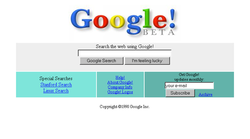
The name "Google" originated from a misspelling of "googol,"[12][13] which refers to the number represented by a 1 followed by one-hundred zeros (although Enid Blyton used the word decades earlier in "Google Bun" - Chapter IX, The Magic Faraway Tree). Having found its way increasingly into everyday language, the verb, "google," was added to the Merriam Webster Collegiate Dictionary and the Oxford English Dictionary in 2006, meaning, "to use the Google search engine to obtain information on the Internet."[14][15]
By the end of 1998, Google had an index of about 60 million pages.[16] The home page was still marked "BETA", but an article in Salon.com already argued that Google's search results were better than those of competitors like Hotbot or Excite.com, and praised it for being more technologically innovative than the overloaded portal sites (like Yahoo!, Excite.com, Lycos, Netscape's Netcenter, AOL.com, Go.com and MSN.com) which at that time, during the growing dot-com bubble, were seen as "the future of the Web", especially by stock market investors.[16]
In March 1999, the company moved into offices at 165 University Avenue in Palo Alto, home to several other noted Silicon Valley technology startups.[17] After quickly outgrowing two other sites, the company leased a complex of buildings in Mountain View at 1600 Amphitheatre Parkway from Silicon Graphics (SGI) in 1999.[18] The company has remained at this location ever since, and the complex has since become known as the Googleplex (a play on the word googolplex, a number that is equal to 1 followed by a googol of zeros). In 2006, Google bought the property from SGI for $319 million.[19]
The Google search engine attracted a loyal following among the growing number of Internet users, who liked its simple design.[20] In 2000, Google began selling advertisements associated with search keywords.[1] The ads were text-based to maintain an uncluttered page design and to maximize page loading speed.[1] Keywords were sold based on a combination of price bid and click-throughs, with bidding starting at $.05 per click.[1] This model of selling keyword advertising was pioneered by Goto.com (later renamed Overture Services, before being acquired by Yahoo! and rebranded as Yahoo! Search Marketing).[21][22][23] While many of its dot-com rivals failed in the new Internet marketplace, Google quietly rose in stature while generating revenue.[1]
Google's declared code of conduct is "Don't be evil", a phrase which they went so far as to include in their prospectus (aka "red herring" or "S-1") for their IPO, noting, "We believe strongly that in the long term, we will be better served — as shareholders and in all other ways — by a company that does good things for the world even if we forgo some short term gains."
[edit] Financing and initial public offering
The first funding for Google as a company was secured in August 1998 in the form of a $100,000USD contribution from Andy Bechtolsheim, co-founder of Sun Microsystems, given to a corporation which did not yet exist.[24]
On June 7, 1999, a round of equity funding totalling $25 million was announced[25]; the major investors being rival venture capital firms Kleiner Perkins Caufield & Byers and Sequoia Capital.[24]
In October 2003, while discussing a possible initial public offering of shares (IPO), Microsoft approached the company about a possible partnership or merger.[citation needed] However, no such deal ever materialized. In January 2004, Google announced the hiring of Morgan Stanley and Goldman Sachs Group to arrange an IPO. The IPO was projected to raise as much as $4 billion.
On April 29, 2004, Google made an S-1 form SEC filing for an IPO to raise as much as $2,718,281,828. This alludes to Google's corporate culture with a touch of mathematical humor as e ≈ 2.718281828. April 29 was also the 120th day of 2004, and according to section 12(g) of the Securities Exchange Act of 1934, "a company must file financial and other information with the SEC 120 days after the close of the year in which the company reaches $10 million in assets and/or 500 shareholders, including people with stock options."[26] Google has stated in its annual filing for 2004 that every one of its 3,021 employees, "except temporary employees and contractors, are also equity holders, with significant collective employee ownership", so Google would have needed to make its financial information public by filing them with the SEC regardless of whether or not they intended to make a public offering. As Google stated in the filing, their, "growth has reduced some of the advantages of private ownership. By law, certain private companies must report as if they were public companies. The deadline imposed by this requirement accelerated our decision." The SEC filing revealed that Google turned a profit every year since 2001 and earned a profit of $105.6 million on revenues of $961.8 million during 2003.
In May 2004, Google officially cut Goldman Sachs from the IPO, leaving Morgan Stanley and Credit Suisse First Boston as the joint underwriters. They chose the unconventional way of allocating the initial offering through an auction (specifically, a "Dutch auction"), so that "anyone" would be able to participate in the offering. The smallest required account balances at most authorized online brokers that are allowed to participate in an IPO, however, are around $100,000. In the run-up to the IPO the company was forced to slash the price and size of the offering, but the process did not run into any technical difficulties or result in any significant legal challenges. The initial offering of shares was sold for $85 a piece. The public valued it at $100.34 at the close of the first day of trading, which saw 22,351,900 shares change hands.
Google's initial public offering took place on August 19, 2004. A total of 19,605,052 shares were offered at a price of $85 per share.[27] Of that, 14,142,135 (another mathematical reference as √2 ≈ 1.4142135) were floated by Google and 5,462,917 by selling stockholders. The sale raised US$1.67 billion, and gave Google a market capitalization of more than $23 billion.[28] The vast majority of Google's 271 million shares remained under Google's control. Many of Google's employees became instant paper millionaires. Yahoo!, a competitor of Google, also benefited from the IPO because it owns 2.7 million shares of Google.[29]
The company is listed on the NASDAQ stock exchange under the ticker symbol GOOG.
[edit] Growth
The first iteration of Google production servers was built with inexpensive hardware and was designed to be very fault-tolerant
In February 2003, Google acquired Pyra Labs, owner of Blogger, a pioneering and leading web log hosting website. Some analysts considered the acquisition inconsistent with Google's business model. However, the acquisition secured the company's competitive ability to use information gleaned from blog postings to improve the speed and relevance of articles contained in a companion product to the search engine, Google News.
At its peak in early 2004, Google handled upwards of 84.7% of all search requests on the World Wide Web through its website and through its partnerships with other Internet clients like Yahoo!, AOL, and CNN. In February 2004, Yahoo! dropped its partnership with Google, providing an independent search engine of its own. This cost Google some market share, yet Yahoo!'s move highlighted Google's own distinctiveness, and today the verb "to google" has entered a number of languages (first as a slang verb and now as a standard word), meaning, "to perform a web search" (a possible indication of "Google" becoming a genericized trademark).
Analysts speculate that Google's response to its separation from Yahoo! will be to continue to make technical and visual enhancements to personalized searches, using the personal data that is gathering from orkut, Gmail, and Google Product Search to produce unique results based on the user. Frequently, new Google enhancements or products appear in its inventory. Google Labs, the experimental section of Google.com, helps Google maximize its relationships with its users by including them in the beta development, design and testing stages of new products and enhancements of already existing ones.[30]
After the IPO, Google's stock market capitalization rose greatly and the stock price more than quadrupled. On August 19, 2004 the number of shares outstanding was 172.85 million while the "free float" was 19.60 million (which makes 89% held by insiders). In January 2005 the number of shares outstanding was up 100 million to 273.42 million, 53% of that was held by insiders, which made the float 127.70 million (up 110 million shares from the first trading day). The two founders are said to hold almost 30% of the outstanding shares. The actual voting power of the insiders is much higher, however, as Google has a dual class stock structure in which each Class B share gets ten votes compared to each Class A share getting one. Page says in the prospectus that Google has, "a dual class structure that is biased toward stability and independence and that requires investors to bet on the team, especially Sergey and me." The company has not reported any treasury stock holdings as of the Q3 2004 report.
On June 1, 2005, Google shares gained nearly four percent after Credit Suisse First Boston raised its price target on the stock to $350. On that same day, rumors circulated in the financial community that Google would soon be included in the S&P 500.[31] When companies are first listed on the S&P 500 they typically experience a bump in share price due to the rapid accumulation of the stock within index funds that track the S&P 500. The rumors, however, were premature and Google was not added to the S&P 500 until 2006. Nevertheless, on June 7, 2005, Google was valued at nearly $52 billion, making it one of the world's biggest media companies by stock market value.
On August 18, 2005 (one year after the initial IPO), Google announced that it would sell 14,159,265 (another mathematical reference as π ≈ 3.14159265) more shares of its stock to raise money. The move would double Google's cash stockpile to $7 billion. Google said it would use the money for "acquisitions of complementary businesses, technologies or other assets".[32]
On September 28, 2005, Google announced a long-term research partnership with NASA which would involve Google building a 1-million square foot R&D center at NASA's Ames Research Center, and on December 31, 2005 Time Warner's AOL unit and Google unveiled an expanded partnership—see Partnerships below.
Additionally in 2005, Google formed a partnership with Sun Microsystems to help share and distribute each other's technologies. As part of the partnership Google will hire employees to help in the open source office program OpenOffice.org.[33]
With Google's increased size comes more competition from large mainstream technology companies. One such example is the rivalry between Microsoft and Google.[34] Microsoft has been touting its MSN Search engine to counter Google's competitive position. Furthermore, the two companies are increasingly offering overlapping services, such as webmail (Gmail vs. Hotmail), search (both online and local desktop searching), and other applications (for example, Microsoft's Windows Live Local competes with Google Earth). Some have even suggested that in addition to an Internet Explorer replacement Google is designing its own Linux-based operating system called Chrome OS to directly compete with Microsoft Windows. There were also rumors of a Google web browser, fueled much by the fact that Google is the owner of the domain name "gbrowser.com". These were later proven when Google released Google Chrome. This corporate feud is most directly expressed in hiring offers and defections. Many Microsoft employees who worked on Internet Explorer have left to work for Google. This feud boiled over into the courts when Kai-Fu Lee, a former vice-president of Microsoft, quit Microsoft to work for Google. Microsoft sued to stop his move by citing Lee's non-compete contract (he had access to much sensitive information regarding Microsoft's plans in China).
Google and Microsoft reached a settlement out of court on 22 December 2005, the terms of which are confidential.[35]
Click fraud has also become a growing problem for Google's business strategy. Google's CFO George Reyes said in a December 2004 investor conference that "something has to be done about this really, really quickly, because I think, potentially, it threatens our business model."[36] Some have suggested that Google is not doing enough to combat click fraud. Jessie Stricchiola, president of Alchemist Media, called Google, "the most stubborn and the least willing to cooperate with advertisers", when it comes to click fraud.
While the company's primary market is in the web content arena, Google has also recently began to experiment with other markets, such as radio and print publications. On January 17, 2006, Google announced that it had purchased the radio advertising company dMarc, which provides an automated system that allows companies to advertise on the radio.[37] This will allow Google to combine two advertising media—the Internet and radio—with Google's ability to laser-focus on the tastes of consumers. Google has also begun an experiment in selling advertisements from its advertisers in offline newspapers and magazines, with select advertisements in the Chicago Sun-Times.[38] They have been filling unsold space in the newspaper that would have normally been used for in-house advertisements.
During the third quarter 2005 Google Conference Call, Eric Schmidt said, "We don't do the same thing as everyone else does. And so if you try to predict our product strategy by simply saying well so and so has this and Google will do the same thing, it's almost always the wrong answer. We look at markets as they exist and we assume they are pretty well served by their existing players. We try to see new problems and new markets using the technology that others use and we build."
After months of speculation, Google was added to the Standard & Poor's 500 index (S&P 500) on March 31, 2006.[39] Google replaced Burlington Resources, a major oil producer based in Houston that had been acquired by ConocoPhillips.[40]. The day after the announcement Google's share price rose by 7%[41].
Over the course of the past decade, Google has become quite well known for its corporate culture and innovative, clean products, and has had a major impact on online culture. In July 2006, the verb, "to google", was officially added to both the Merriam Webster Collegiate Dictionary as well as the Oxford English Dictionary, meaning, "to use the Google search engine to obtain information on the Internet."[42][43]
[edit] Philanthropy
In 2004, Google formed a non-profit philanthropic wing, Google.org, giving it a starting fund of $1 billion.[44] The express mission of the organization is to help with the issues of climate change (see also global warming), global public health, and global poverty. Among its first projects is to develop a viable plug-in hybrid electric vehicle that can attain 100 mpg. [45]
[edit] Acquisitions
Main article: List of Google acquisitions
Since 2001, Google has acquired several small start-up companies, often consisting of innovative teams and products. One of the earlier companies that Google bought was Pyra Labs. They were the creators of Blogger, a weblog publishing platform, first launched in 1999. This acquisition led to many premium features becoming free. Pyra Labs was originally formed by Evan Williams, yet he left Google in 2004. In early 2006, Google acquired Upstartle, a company responsible for the online collaborative word processor, Writely. The technology in this product was combined with Google Spreadsheets to become Google Docs & Spreadsheets.
On October 9, 2006, Google announced that it would buy the popular online video site YouTube for $1.65 billion.[46] The brand, YouTube, will continue to exist, and will not merge with Google Video. Meanwhile, Google Video signed an agreement with Sony BMG Music Entertainment and the Warner Music Group, for both companies to deliver music videos to the site.[47] The deal was finalized by November 13.[48]
On October 31, 2006, Google announced that it had purchased JotSpot, a company that helped pioneer the market for collaborative, web-based business software to bolster its position in the online document arena. [49]
On March 17, 2007, Google announced its acquisition of two more companies. The first is Gapminder's Trendalyzer software, a company that specializes in developing information technology for provision of free statistics in new visual and animated ways[50] On the same day, Google also announced its acquisition of Adscape Media, a small in-game advertising company based in San Francisco, California.[51]
Google also acquired PeakStream Technologies.
[edit] Partnerships
Google has worked with several corporations, in order to improve production and services. On September 28, 2005,Google announced a long-term research partnership with NASA which would involve Google building a 1-million square foot R&D center at NASA's Ames Research Center. NASA and Google are planning to work together on a variety of areas, including large-scale data management, massively distributed computing, bio-info-nano convergence, and encouragement of the entrepreneurial space industry. The new building would also include labs, offices, and housing for Google engineers.[52] In October 2006, Google formed a partnership with Sun Microsystems to help share and distribute each other's technologies. As part of the partnership Google will hire employees to help the open source office program OpenOffice.org.[53]
Time Warner's AOL unit and Google unveiled an expanded partnership on December 21, 2005, including an enhanced global advertising partnership and a $1 billion investment by Google for a 5% stake in AOL.[54] As part of the collaboration, Google plans to work with AOL on video search and offer AOL's premium-video service within Google Video. This did not allow users of Google Video to search for AOL's premium-video services. Display advertising throughout the Google network will also increase.
In August 2003, Google signed a $900 million offer with News Corp.'s Fox Interactive Media unit to provide search and advertising on MySpace and other News Corp. websites including IGN, AmericanIdol.com, Fox.com, and Rotten Tomatoes, although Fox Sports is not included as a deal already exists between News Corp. and MSN.[55][56]
On 6 December 2006, British Sky Broadcasting released details of a Sky and Google alliance.[57] This includes a feature where Gmail will link with Sky and host a mail service for Sky, incorporating the email domain "@sky.com".
In January 2009, Google announced a partnership with the Pontifical Council for Social Communications, allowing the Pope to have his own channel on YouTube. [58]
[edit] New mobile top-level domain
In coordination with several other major corporations, including Microsoft, Nokia, Samsung, and Ericsson, Google provided financial support in the launch of the .mobi top level domain created specifically for the mobile internet, stating that it is supporting the new domain extension to help set the standards that will define the future of mobile content and improve the experience of Google users.[59] In early 2006, Google launched Google.mobi, a mobile search portal offering several Google mobile products, including stripped-down versions of its applications and services for mobile users.[60] On September 17, 2007, Google launched, "Adsense for Mobile", a service to its publishing partners providing the ability to monetize their mobile websites through the targeted placement of mobile text ads.[61] Also in September, Google acquired the mobile social networking site, Zingku.mobi, to "provide people worldwide with direct access to Google applications, and ultimately the information they want and need, right from their mobile devices."[62]
[edit] Legal battles
[edit] Gonzalez v. Google
On Wednesday, January 18, 2006, the U.S. Justice Department filed a motion to compel in United States district court in San Jose seeking a court order that would compel search engine company Google Inc. to turn over, "a multi-stage random sample of one million URL’s", from Google’s database, and a computer file with, "the text of each search string entered onto Google’s search engine over a one-week period (absent any information identifying the person who entered such query)."[63] Google maintains that their policy has always been to assure its users privacy and anonymity, and challenged the subpoena. On March 18, 2006, a federal judge ruled that while Google must surrender 50,000 random URLs, the Department of Justice did not meet the necessary burden to force Google to disclose any search terms entered by its users.
History of photography

The word photography derives from the Greek words 'fos' - meaning light and 'grafo' - to write. The word was popularized by Sir John Herschel in 1839. Modern photography began in the 1820s with the first permanent photographs.
Photography is the result of combining several technical discoveries. Long before the first photographs were made, Chinese philosopher Mo Ti and Greek philosophers such as Aristotle and Euclid described a pinhole camera in the 5th and 4th centuries B.C.E,[1][2] Ibn al-Haytham (Alhazen) (965–1040) studied the camera obscura and pinhole camera,[2][3] Albertus Magnus (1193/1206-1280) discovered silver nitrate, and Georges Fabricius (1516-1571) discovered silver chloride. Daniel Barbaro described a diaphragm in 1568. Wilhelm Homberg described how light darkened some chemicals (photochemical effect) in 1694. The novel Giphantie (by the French Tiphaigne de la Roche, 1729-1774) described what can be interpreted as photography.
For years images have been projected onto surfaces. According to the Hockney–Falco thesis as argued by artist David Hockney,[4] some artists used the camera obscura and camera lucida to trace scenes as early as the 16th century. However, this theory is heavily disputed by today's contemporary realist artists who are able to create high levels of realism without optical aids.[5] These early cameras did not record an image, but only projected images from an opening in the wall of a darkened room onto a surface, turning the room into a large pinhole camera. The phrase camera obscura literally means dark chamber. While this early prototype of today's modern camera may have had modest usage in its time, it was an important step in the evolution of the invention.
MONOCHROME PROCESS
The first permanent photograph was an image produced in 1825 by the French inventor Joseph Nicéphore Niépce. His photographs were produced on a polished pewter plate covered with a petroleum derivative called bitumen of Judea. Bitumen hardens with exposure to light. The unhardened material may then be washed away and the metal plate polished, rendering a negative image which then may be coated with ink and impressed upon paper, producing a print. Niépce then began experimenting with silver compounds based on a Johann Heinrich Schultz discovery in 1724 that a silver and chalk mixture darkens when exposed to light.
In partnership, Niépce (in Chalon-sur-Saône) and Louis Daguerre (in Paris) refined the existing silver process.[6] In 1833 Niépce died of a stroke, leaving his notes to Daguerre. While he had no scientific background, Daguerre made two pivotal contributions to the process. He discovered that exposing the silver first to iodine vapour before exposure to light, and then to mercury fumes after the photograph was taken, could form a latent image. Bathing the plate in a salt bath then fixes the image. On January 7, 1839 Daguerre announced that he had invented a process using silver on a copper plate called the daguerreotype.[7] The French government bought the patent and immediately made it public domain.
In 1832, French-Brazilian painter and inventor Hercules Florence had already created a very similar process, naming it Photographie.
After reading about Daguerre's invention, Fox Talbot worked on perfecting his own process; in 1839 he got a key improvement, an effective fixer, from John Herschel, the astronomer, who had previously showed that hyposulfite of soda (also known as hypo, or now sodium thiosulfate) would dissolve silver salts. Later that year, Herschel made the first glass negative.
By 1840, Talbot had invented the calotype process. He coated paper sheets with silver chloride to create an intermediate negative image. Unlike a daguerreotype, a calotype negative could be used to reproduce positive prints, like most chemical films do today. Talbot patented[8] this process, which greatly limited its adoption. He spent the rest of his life in lawsuits defending the patent until he gave up on photography. Later George Eastman refined Talbot's process, which is the basic technology used by chemical film cameras today. Hippolyte Bayard had also developed a method of photography but delayed announcing it, and so was not recognized as its inventor.
In 1839, John Herschel made the first glass negative, but his process was difficult to reproduce. Slovene Janez Puhar invented a process for making photographs on glass in 1841; it was recognized on June 17, 1852 in Paris by the Académie Nationale Agricole, Manufacturière et Commerciale.[9] In 1847, Niépce St. Victor published his invention of a process for making glass plates with an albumen emulsion; the Langenheim brothers of Philadelphia and John Whipple of Boston also invented workable negative-on-glass processes in the mid 1840s.[10]
In 1851 Frederick Scott Archer invented the collodion process.[citation needed] Photographer and children's author Lewis Carroll used this process.[citation needed]
Roger Fenton's assistant seated on Fenton's photographic van, Crimea, 1855.
Herbert Bowyer Berkeley experimented with his own version of collodian emulsions after Samman introduced the idea of adding dithionite to the pyrogallol developer.[citation needed] Berkeley discovered that with his own addition of sulfite, to absorb the sulfur dioxide given off by the chemical dithionite in the developer, that dithionite was not required in the developing process. In 1881 he published his discovery. Berkeley's formula contained pyrogallol, sulfite and citric acid. Ammonia was added just before use to make the formula alkaline. The new formula was sold by the Platinotype Company in London as Sulpho-Pyrogallol Developer.[11]
Nineteenth-century experimentation with photographic processes frequently became proprietary. The German-born, New Orleans photographer Theodore Lilienthal successfully sought legal redress in an 1881 infringement case involving his "Lambert Process" in the Eastern District of Louisiana.
[edit] Popularization
Mid 19th century "Brady stand" photo model's armrest table, meant to keep portrait models more still during long exposure times (studio equipment nicknamed after the famed US photographer, Mathew Brady).
A photographer appears to be photographing himself in a 19th-century photographic studio. (c. 1893)
The daguerreotype proved popular in responding to the demand for portraiture emerging from the middle classes during the Industrial Revolution.[citation needed] This demand, that could not be met in volume and in cost by oil painting, added to the push for the development of photography. By 1851 a broadside by daguerreotypist Augustus Washington was advertising prices ranging from 50 cents to $10.[12] However, daguerreotypes were fragile and difficult to copy. Photographers encouraged chemists to refine the process of making many copies cheaply, which eventually led them back to Talbot's process.
Ultimately, the modern photographic process came about from a series of refinements and improvements in the first 20 years. In 1884 George Eastman, of Rochester, New York, developed dry gel on paper, or film, to replace the photographic plate so that a photographer no longer needed to carry boxes of plates and toxic chemicals around. In July 1888 Eastman's Kodak camera went on the market with the slogan "You press the button, we do the rest". Now anyone could take a photograph and leave the complex parts of the process to others, and photography became available for the mass-market in 1901 with the introduction of the Kodak Brownie.
In the twentieth century, photography developed rapidly as a commercial service. End-user supplies of photographic equipment accounted for only about 20 percent of industry revenue. For the modern enthusiast photographer processing black and white film, little has changed since the introduction of the 35mm film Leica camera in 1925.[citation needed]
[edit] Color process
First color image, photograph by James Maxwell, 1861.
Although color photography was explored throughout the 19th century, initial experiments in color resulted in projected temporary images, rather than permanent color images. Moreover until the 1870s the emulsions available were not sensitive to red or green light.
The first color photo, an additive projected image of a tartan ribbon, was taken in 1861 by the Scottish physicist James Clerk Maxwell.[13] Several patentable methods for producing images (by either additive or subtractive methods, see below) were devised from 1862 on by two French inventors (working independently), Louis Ducos du Hauron and Charles Cros.[14] Practical methods to sensitize silver halide film to green and then orange light were discovered in 1873 and 1884 by Hermann W. Vogel (full sensitivity to red light was not achieved until the early years of the 20th century).
The first fully practical color plate, Autochrome, did not reach the market until 1907. It was based on a screen-plate method, the screen (of filters) being made using dyed dots of potato starch. The screen lets filtered red, green or blue light through each grain to a photographic emulsion in contact with it. The plate is then developed to a negative, and reversed to a positive, which when viewed through the screen restores colors approximating the original.
Other systems of color photography included that used by Sergei Mikhailovich Prokudin-Gorskii, which involved three separate monochrome exposures ('separation negatives') of a still scene through red, green, and blue filters. These required a special machine to display, but the results are impressive even by modern standards. His collection of glass plates was purchased from his heirs by the Library of Congress in 1948, and is now available in digital images.
Development of digital photography
Main article: Digital photography
A Canon PowerShot A95
The charge-coupled device (CCD) was invented in 1969 by Willard Boyle and George E. Smith at AT&T Bell Labs. The lab was working on the Picturephone and on the development of semiconductor bubble memory. Merging these two initiatives, Boyle and Smith conceived of the design of what they termed 'Charge "Bubble" Devices'. The essence of the design was the ability to transfer charge along the surface of a semiconductor.
* 1973 - Fairchild Semiconductor releases the first large image forming CCD chip; 100 rows and 100 columns.
* 1975 - Bryce Bayer of Kodak develops the Bayer filter mosaic pattern for CCD color image sensors
* 1986 - Kodak scientists develop the world's first megapixel sensor.
When the missisippi river nearly froze

Four consecutive days during the winter of 1899 brought extreme harsh conditions to North America. Known as “The Great Cold Wave”, many record-setting low temperatures which were set still hold to this day in many cities.
On February 14 1899, Tallahassee, Florida saw temperatures as cold as -2°F (-18.9° C). This is still the coldest temperature ever recorded in Florida. Other locations that saw rare low temperatures include Dallas, Texas at -10°F (-23.3° C), Kansas City, Missouri at -22°F (-30° C), and Scottsbluff, Nebraska at -45°F (-42.8° C). All records which still stand.
This was the year when the Mississippi River froze its entire length down to the Gulf of Mexico. In fact, some ice even flowed into the Gulf. In places like Cairo, Illinois the thickness of the ice was 13 inches. Ice two inches thick reached New Orleans and ice an inch thick was observed at the mouth of the river.
During the approximate four day stretch, many places were lucky if the high temperature reach zero degrees. The Blizzard of 1899 was a benchmark storm for the South. Florida still measures their snowfall totals for a day or storm against the 1899 storm, sometimes referred to as the “greatest cold snap in American history.”
Subscribe to:
Posts (Atom)